C-DRONE GUIDE · 19 MAY 2026
Construction monitoring: drone or fixed timelapse camera? The comparison
To document a construction project, two tools share the market: regular drone visits and the fixed 4G-connected timelapse camera. They are often pitched as competitors; in reality they do not answer the same need. Here is the method-versus-method comparison — costs, deliverables, blind spots — to choose with full knowledge, or combine both intelligently.
Two tools, two kinds of information
The timelapse box is a fixed, permanent eye: an autonomous unit (high-definition camera, solar panel or mains power, 4G SIM) mounted on a mast or crane, photographing the site every 10 to 30 minutes for months. It produces a film of the complete evolution, viewable remotely in near real time, with zero human intervention. Its strength is continuity; its weakness, the single viewpoint: it only sees what happens inside its frame, from its angle, and nothing behind the first obstacle that rises in front of it.
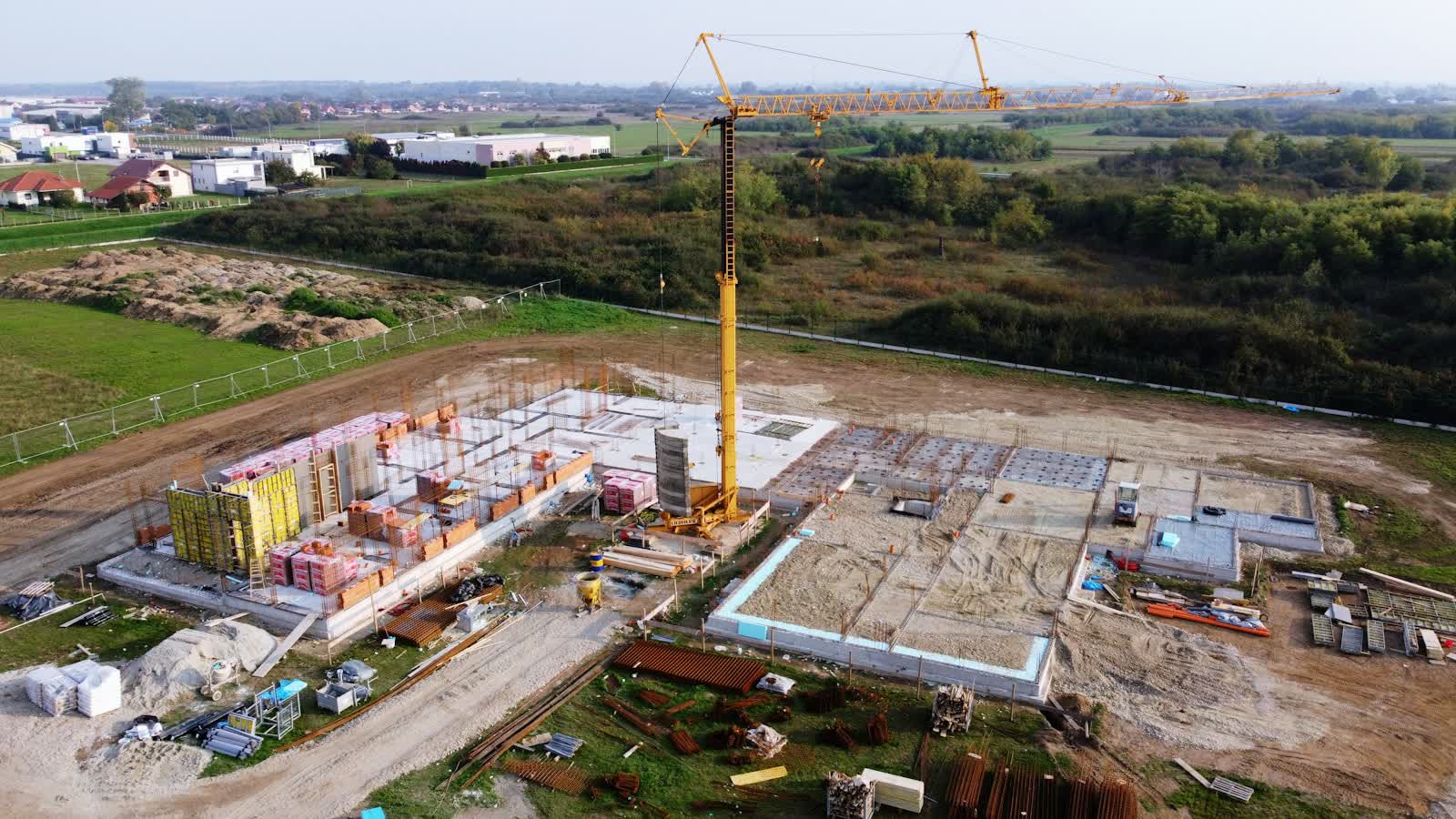
The drone is the exact opposite: a mobile, periodic eye. On each visit — weekly, fortnightly or monthly — it circles the site, climbs vertically, moves in on façades, and produces views impossible from a mast. Above all, it is not limited to communication imagery: equipped for photogrammetry, it turns the site into measurable data — georeferenced orthophotos, 3D models, earthworks volume calculations. So the question is not "which is better?" but "what information do I need: a continuous feed of context, or precise surveys and high-quality images?".
The head-to-head in numbers
Here are the orders of magnitude observed on the French market in 2026, for a medium-sized project (building, business park, civil structure):
| Criterion | Drone (regular visits) | 4G timelapse box |
|---|---|---|
| Cost | €50 – €150 per simple timelapse visit; €320 – €690 per full visit with photogrammetry | €150 – €400/month rented, or €2,000 – €6,000 purchased + platform subscription |
| Typical annual monitoring | €5,000 – €15,000 (12 to 24 visits, technical deliverables included) | €1,800 – €4,800 (one camera, end-of-project film included) |
| Capture frequency | Periodic (per visit) | Continuous (every 10–30 min) |
| Viewpoints | Unlimited, 360°, vertical, close to façades | One fixed frame per camera |
| Technical deliverables | Orthophotos, 3D, volumes, comparison against the design model | None (imagery only) |
| Human intervention | Pilot on every visit | Installation then fully autonomous |
| Weather sensitivity | Postponements possible (wind, rain) | Insensitive (captures in all weather) |
Quick read: for the same annual budget, the box captures a thousand times more images; the drone produces a hundred times more usable information per image.
The cases where the timelapse box wins
The box wins when the need is continuity. First case: institutional communication on a long project — 18 to 36 months — where you want, at handover, the complete accelerated film from earthworks to ribbon-cutting. No rhythm of drone visits will reconstruct that material. Second case: remote activity monitoring. A project owner or developer running several operations checks the previous day's images every morning, verifies a delivery arrived, sees real progress before a site meeting — without moving anyone. Third case: traceability in disputes. Continuous timestamping establishes that a crane really was idle that week, or that a storage area was indeed moved on that date.
The box also enjoys regulatory simplicity: mounted on a mast within the site boundary, it is subject to no aviation rule — only to image rights (frame the site, not the street or neighbouring buildings, and record it in the project's GDPR register). Its limits are just as clear: as soon as the building rises, a ground-level camera loses half the site; interior phases escape it entirely; and its image, shot through a weatherproof housing, never rivals a carefully framed capture for commercial materials.
The cases where the drone is irreplaceable
The drone becomes indispensable as soon as the project needs measurements or viewpoints. During earthworks, a monthly photogrammetric flight yields the real cut-and-fill volumes — enough to check the groundworks contractor's progress claims to the cubic metre, an issue that quickly runs into tens of thousands of euros. During structural work, the georeferenced orthophoto overlaid on the execution drawings reveals positioning deviations while there is still time to correct them. Our guide to photogrammetry and BIM on site details these deliverables and their centimetre-level accuracy.
The drone is also the only one to document what the box will never see: the state of roofs and parapets before handover, façades mid-installation, zones masked by neighbouring buildings, and "future" views — the image taken at the exact height of the future sixth-floor balcony that feeds the developer's sales office. Finally, on the regulatory side, an urban site requires the pilot to file a préfecture declaration with ten working days' notice: on a recurring drone construction-monitoring contract, the operator files declarations covering several slots, and that constraint vanishes from the site manager's daily life.
The hybrid strategy: the standard on well-monitored projects
On significant operations, the drone-versus-box debate was settled long ago: you take both, each in the right dose. The typical setup for a 24-month project looks like this: a timelapse box installed as soon as the site is fenced (€2,500 to €4,000 over the duration), running unattended and providing the inauguration film; a monthly photogrammetric drone visit during earthworks and structural phases, then quarterly during fit-out (€6,000 to €10,000); and two polished "image" sessions, at weathertight stage and at handover, for commercial materials.
Total budget: in the region of €9,000 to €15,000 over two years — a negligible fraction of the operation's cost — for complete coverage: communication, project control, measurements, pre-litigation evidence. Two arbitration tips for tight budgets. If the project is short (under 8 months) and mostly technical (earthworks, utilities), the drone alone is enough: the timelapse material of a short project is easily reconstructed from weekly €50–150 visits. If the project is long and the stake purely communicational, the box alone does the job, completed by a single drone flight at handover for the final beauty shots.
Frequently asked questions
How much does a drone construction timelapse cost? Allow €50 to €150 per visit for a series of shots repeated from the same waypoints, and €5,000 to €15,000 for full annual monitoring including photogrammetric deliverables. A fixed box rents for €150–400 per month.
Is a permit required to fly over a construction site? Outside built-up areas, a declared professional pilot flies over an access-controlled site with no special formality. In built-up areas, a prior préfecture declaration is mandatory, with ten working days' notice — build it into the visit schedule.
Does the timelapse box need a declaration? None under aviation law, but it films continuously: it must appear in the project's GDPR processing register, frame only the works area and be signposted.
Can volumes be measured with a box? No. Only a photogrammetric drone flight produces georeferenced orthophotos and 3D models enabling volume calculations and positioning checks. That is the fundamental technical boundary between the two tools.