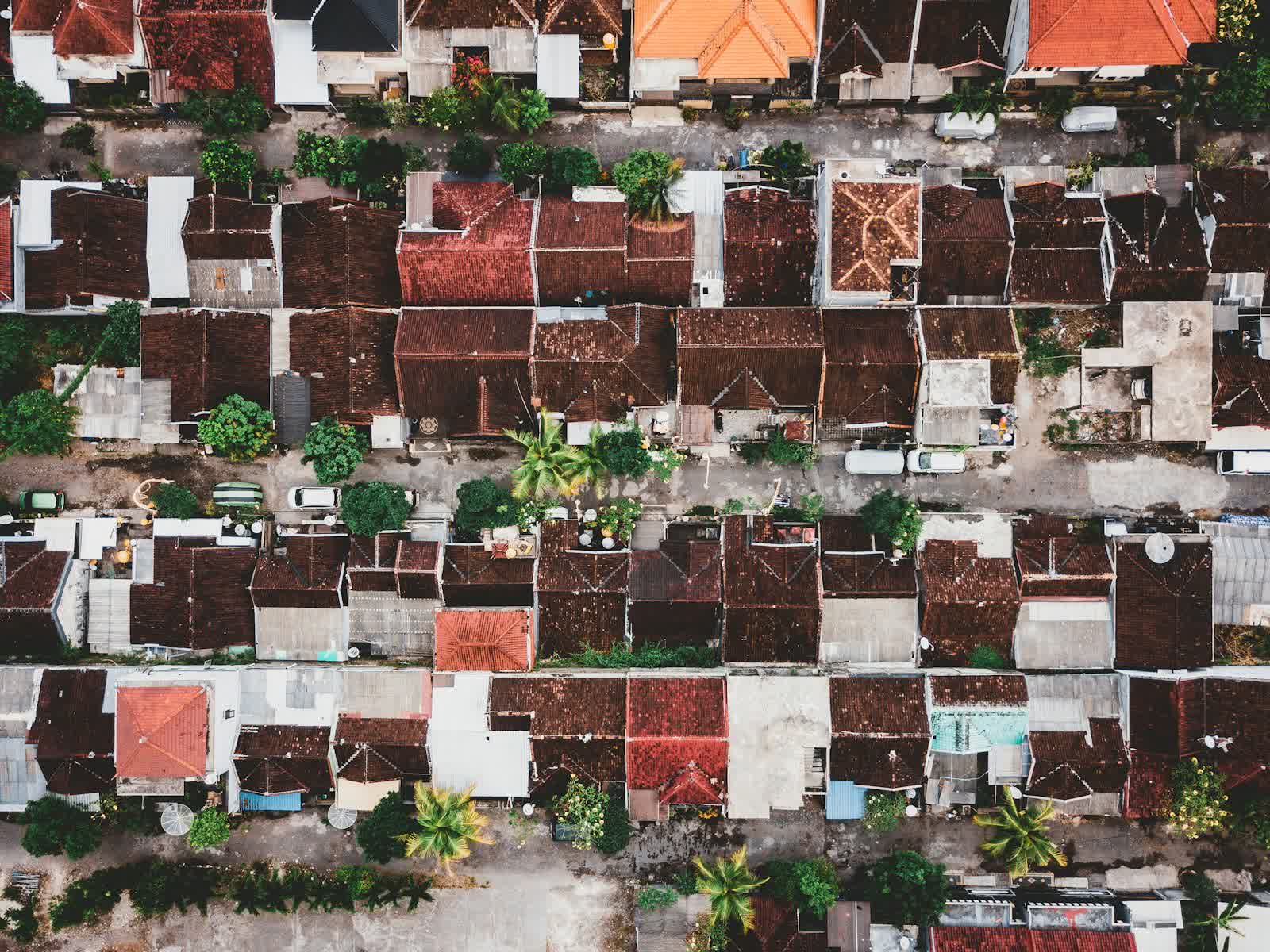
C-DRONE GUIDE · 5 MAY 2026
Drone roof cleaning: reviews, prices, does it actually work?
Drone roof cleaning is booming in France, driven by franchises and contractors equipped with spraying drones. The promise: treat your roof without scaffolding, without walking on the tiles, in about an hour. But does it actually work, or is it a marketing gimmick? Here is an honest assessment: what the method does well, what it does not do, the real prices observed and what customers who tried it have to say.
How it works: a spraying drone, not a pressure washer
First clarification, because it is the source of most misunderstandings: a roof-cleaning drone does not scour your roof. It carries a 10 to 30-litre tank and a spray boom, and applies a treatment product — a curative anti-moss agent, then possibly a water repellent — evenly across the whole surface. It is the aerial equivalent of a roofer's sprayer, not of a pressure washer.
The typical process: the pilot first inspects the roof with photos or video to assess the state of the tiles and locate the most colonised areas, then makes several spraying passes a few metres above the roof. The product then works over several weeks: the moss browns, dries out and is progressively removed by rain and wind. Allow two to six months for a complete visual result, depending on how thick the growth is. Some operators offer a second, water-repellent pass once the roof is clean, to delay regrowth by three to five years.
Does it actually work? What real jobs show
Yes, on its own turf: the anti-moss treatment sprayed by drone is chemically identical to the one a roofer applies by hand. At equal dosage, effectiveness is the same — and coverage is often more even, because the drone treats areas a ground operator struggles to reach (ridges, valleys, north-facing slopes). Six-month follow-ups show moss-free roofs in the vast majority of correctly dosed jobs.
No, on what it is sometimes made to promise: the drone does not scrape off moss several centimetres thick (a single treatment will take longer, or a second pass will be needed), it does not replace broken tiles, does not redo ridge pointing and does not clear gutters. An honest operator will say so upfront and, when the roof is heavily soiled, will suggest prior manual brushing or a double treatment. And that is precisely the method's great side benefit: nobody walks on your tiles. On an old or fragile roof (canal tiles, thin slates), every human pass breaks a few elements; the drone applies no weight at all.
Prices observed in 2026
The market has settled around a price per square metre, with flat rates for standard houses. Here are the ranges actually observed in France in 2026:
| Service | Observed price |
|---|---|
| Anti-moss drone treatment (curative only) | €6 to €10/m² |
| Anti-moss treatment + water repellent | €10 to €14/m² |
| Flat rate, 100-150 m² house roof | €499 to €699 |
| Large roof (agricultural, industrial building) | Degressive, on quote |
| Traditional manual moss removal (brushing + treatment) | €15 to €35/m², excluding scaffolding |
| Preliminary photo inspection of the roof | Often included, otherwise €80 to €150 |
The gap with the traditional method is easy to explain: no scaffolding to erect, no cherry picker to hire, no half-day with two workers on the roof. A drone job on a standard house takes one to two hours. Beware of quotes far below these ranges: under-dosed product, missing insurance or an undeclared operator are the usual explanations.
What customer reviews say — the good and the not so good
In positive reviews, three points come up consistently: speed (one morning, versus several days with scaffolding), zero damage to the tiles, and the price, often 30 to 50% below a traditional moss removal once scaffolding is counted in. Owners of hard-to-access roofs — tall buildings, steep pitches, fragile tiles — are logically the most enthusiastic: that is the use case where the alternative costs the most.
In negative reviews, two complaints dominate. First, disappointment over how long results take: some customers expected a clean roof the same evening, whereas the treatment works over several weeks — a serious operator must state this clearly, with before-and-after photos to back it up. Second, sloppy jobs by opportunistic operators: rushed spraying, diluted product, no prior inspection. The checklist is simple: ask for the name and technical datasheet of the product used, the dosage per m², a photo inspection before treatment and a commitment to re-treat any missed areas. An established professional will accept all four requests without blinking.
Drone or roofer: the honest comparison
The drone wins when the roof is sound but colonised: even treatment, lower cost, zero breakage. The roofer remains essential when the roof needs more than a treatment: tiles to replace, very thick moss to remove mechanically, gutters to clear, ridge pointing to redo. Many contractors actually combine both: manual brushing of accessible areas, drone for the rest.
A word on legality, because it conditions quality: drone spraying over private property is a professional service that requires an operator registered on AlphaTango (operator number affixed to the drone), a trained remote pilot and aerial third-party liability insurance, mandatory for any professional use under Regulation (EC) No 785/2004. In a dense housing estate, a prior declaration to the préfecture may be needed on top — allow 10 working days of notice. These requirements automatically rule out the cash-in-hand offers circulating on social media. To dig into the pre-works inspection side, see our comparison roof inspection: drone or cherry picker, and to request a quote, the high-access drone cleaning page.
Frequently asked questions
Is drone roof cleaning effective?
Yes, for anti-moss treatment: the product is the same as the one applied by hand, with often more even coverage. The full visual result takes two to six months. A drone does not replace roof repairs.
How much does drone moss removal cost?
From €6 to €14/m² depending on whether a water repellent is included, i.e. €499 to €699 as a flat rate for a standard house. Manual moss removal costs €15 to €35/m², excluding scaffolding.
How long does the treatment last?
A curative treatment protects for two to four years; with a water repellent, expect three to five years before significant regrowth, depending on exposure and surroundings (trees, humidity).
Is it legal to have your roof treated by drone?
Yes, provided the operator is a registered UAS operator with aerial liability insurance and complies with overflight rules — flying over your own plot with your consent poses no problem.