C-DRONE GUIDE · 9 FEBRUARY 2026
Drone thermography: the energy renovation weapon
With the phased ban on renting energy sieves in France — G-rated since 2025, F in 2028 — and stricter energy performance diagnostics, knowing where a building loses its heat has never been worth more. Drone thermography answers exactly that question: it makes the heat leaks of an entire envelope visible in one morning, roofs included. Provided strict measurement rules are respected — this guide details them.
The principle: measuring radiation, not guessing it
A thermal camera does not "see" indoor heat: it measures the infrared radiation emitted by surfaces. When a poorly insulated wall lets the building's heat escape, its outer surface warms by a few tenths of a degree to a few degrees — that differential is what the camera detects and converts into a coloured image. Professional drone-borne cameras in 2026 (DJI Zenmuse H30T or Matrice 4T class) offer 640×512 radiometric resolution and thermal sensitivity below 50 mK: enough to spot an insulation defect a few dozen centimetres wide from 20 to 30 m away.
The word "radiometric" is decisive: a radiometric image records the measured temperature of every pixel, which can then be processed (emissivity adjustment, spot measurements, isotherms), whereas a mere coloured thermal image is just an illustration. Always require radiometric deliverables. The drone's specific contribution over ground-based thermography comes down to three points: access to roofs — a house's biggest heat-loss item, up to 30% —, a perpendicular view of upper-floor façades (an oblique sight from the ground skews measurements), and fast coverage of large envelopes: residential blocks, schools, industrial buildings.
Measurement conditions: 80% of the result's quality
Building thermography cannot be improvised on a May afternoon. For leaks to be readable, you need a gap of at least 10°C, ideally 15°C, between the heated interior and the outside: the useful season runs from October-November to March in mainland France. The flight happens at night or just before dawn, after several hours without sun: solar radiation stored in materials during the day completely masks the thermal signatures of defects (a sunlit south façade "glows" in infrared for hours). You also need dry weather — evaporating water cools surfaces —, wind below 20 km/h that would otherwise sweep away the differentials, and a building heated normally for the previous 48 h.
These constraints have a direct commercial consequence: usable slots are rare and get booked weeks ahead in high season. Beware of the provider offering thermography "whenever you like": it is the sign they will produce pretty but unusable images. The report must moreover record the flight conditions — indoor and outdoor temperatures, wind, humidity, weather history of the preceding hours — without which no serious interpretation is possible. It is a simple criterion for sorting professionals from sellers of orange-and-purple pictures.
What aerial thermography concretely reveals
On a building envelope, the thermal camera highlights: structural thermal bridges (floor slab edges, lintels, parapets — visible as regular warm lines), insulation installation defects (shifted panels, settled blown wool in attics, forgotten areas drawing geometric warm patches), air leaks at window frames and junctions, and moisture inside walls, betrayed by its different thermal inertia. On roofs, it locates water ingress under the covering and attic insulation defects with a precision visual inspection never reaches.
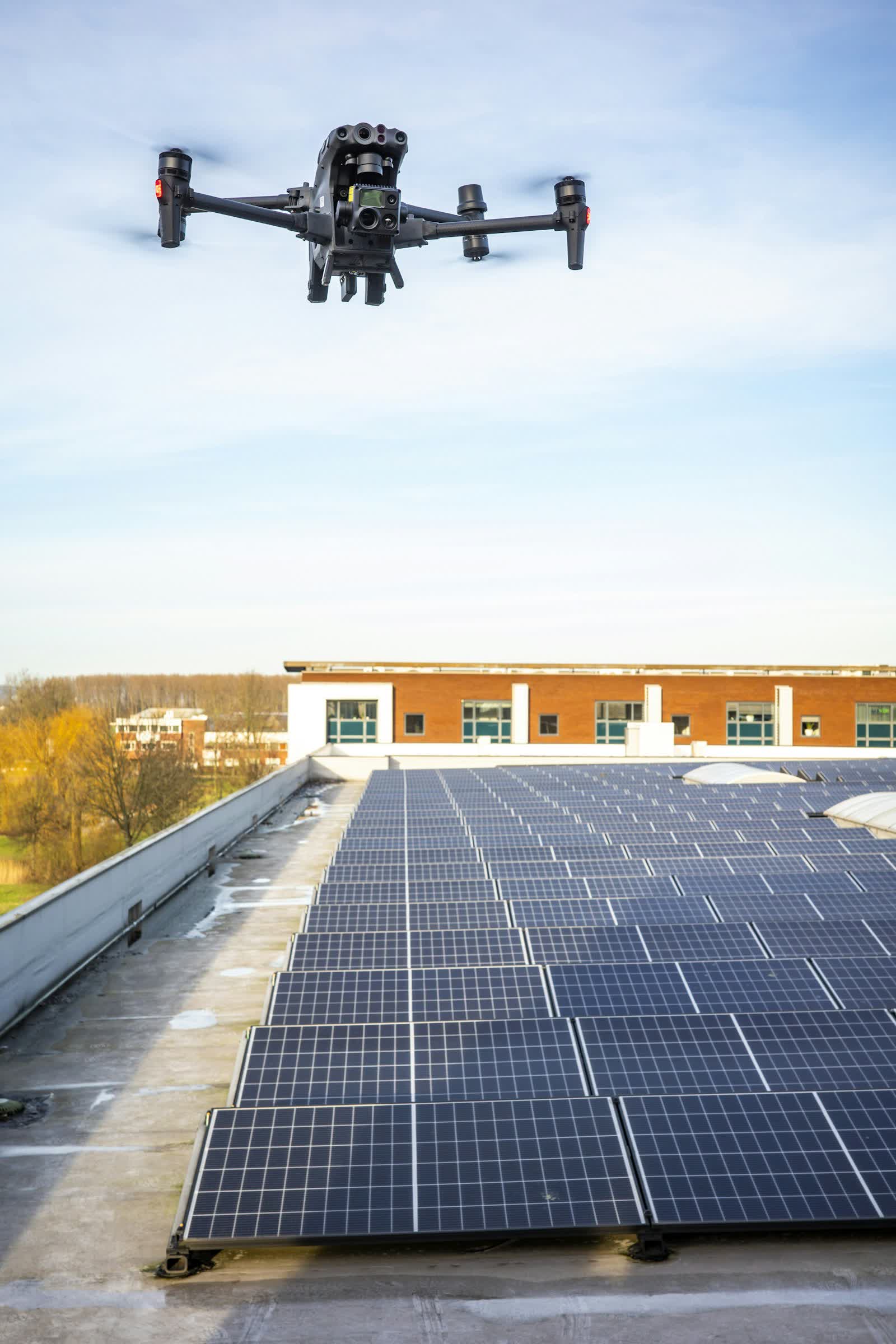
Two complementary applications are growing fast. Before/after renovation audits: thermography before works objectifies the priorities (insulate the attic before changing the windows, in most cases), and a second pass after handover verifies workmanship — a powerful contractual argument against a contractor whose "new" insulation leaks. And photovoltaic plant inspection: defective cells, hot spots and disconnected strings appear instantly in thermal imagery; on 1,000 m² of rooftop panels, the drone does in twenty minutes what no manual check can, and a hot spot caught early sometimes prevents a fire.
What thermography is not: EPC, audits and framework
Let us be precise about the French framework: thermography replaces neither the DPE energy performance certificate nor the regulatory energy audit required to sell E, F or G-rated homes. Those documents follow standardised calculation methods carried out by certified assessors. Thermography is a complementary investigation tool: where the DPE computes theoretical consumption, it shows the real defects, located to the centimetre. That is precisely its value — an energy auditor backed by aerial thermography produces far more targeted recommendations, and engineering firms increasingly include it in their audits of co-owned buildings.
On skills, require the double competence: a registered pilot (AlphaTango UAS operator, specific-category declaration to fly over built-up areas — the general case for buildings) AND an operator trained in building thermography. A thermographer certification (ITC Level 1 or equivalent) is the market's serious standard: interpretation is the core of the job, because a warm patch can be an insulation defect, an embedded heating pipe, a working flue or a mere reflection — only training can tell them apart. A drone without a thermographer produces images; with one, a diagnosis.
2026 prices and deliverables: what to expect
Prices observed in France in 2026: €400 to €700 for a single house (night or dawn flight, radiometric report), €800 to €2,000 for a residential block or office building depending on envelope area, and per-capacity billing for photovoltaics — around €1 to €3 per kWp with a mission minimum of about €500. Grouped campaigns slash unit prices: some municipalities and property managers have a whole neighbourhood or housing stock surveyed over a few nights, at around €150 to €250 per building.
The reference deliverable includes: the analysis report with paired thermal and visual images (every anomaly shown in both spectra), anomaly locations on a plan or orthophoto, measurement parameters and flight conditions, a severity rating per anomaly and prioritised recommendations. The raw radiometric files (R-JPEG formats) must be available on request — your guarantee for a second opinion. Allow a week for delivery. Set against the cost of an energy renovation — €20,000 to €70,000 for a house — the €500 of a thermography that stops you insulating the wrong wall first is probably the best-invested euro of the whole project.